
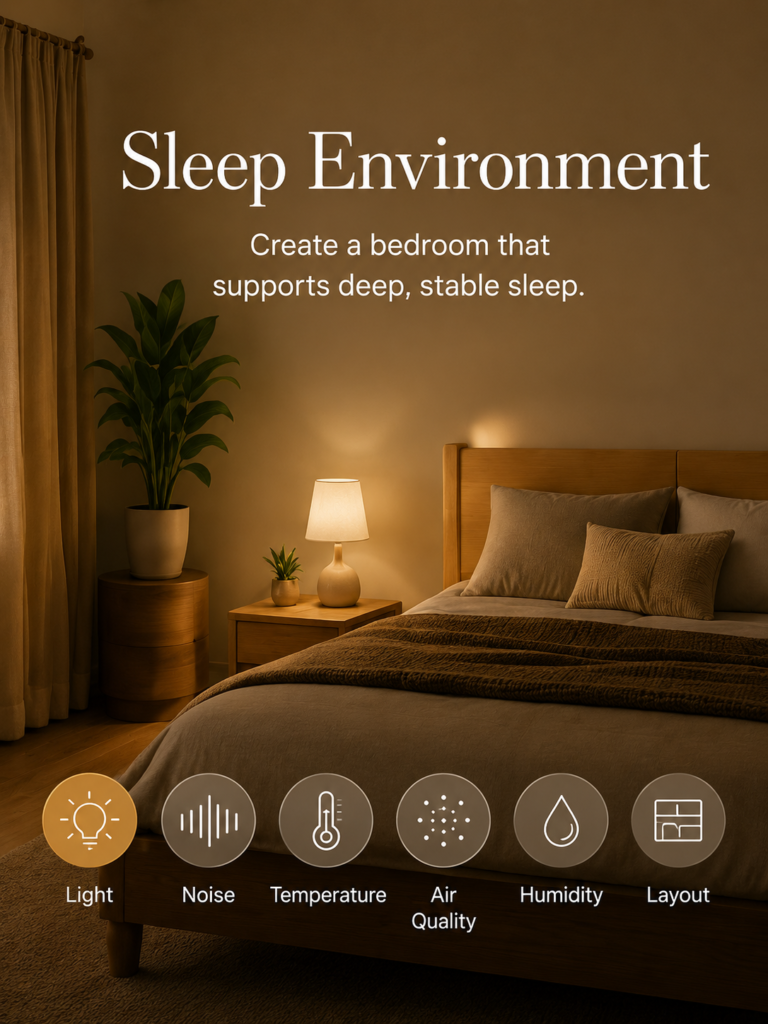
Why Quiet Rooms Help Sleep
TL;DR
A quiet room helps sleep mainly because it reduces the number of signals the brain has to evaluate overnight. The issue is not silence itself. It is the absence of unpredictable sounds that might indicate a need to wake up. Consistent low-level background sound (like a fan) is often better than total silence for light sleepers. Quiet is one layer of sleep comfort, not the only one.
SleepOps Summary
- Main layer
- Sleep Environment
- Common trigger
- Restless Sleep, Difficulty Falling Asleep
- What to try tonight
- Reduce unpredictable sound sources: close windows facing a street, silence phone notifications, move ticking clocks out of the bedroom.
- What to track this week
- track whether the Sleep Environment signal improves or repeats across the next few nights.
- When to seek medical help
- seek qualified care if symptoms are severe, persistent, painful, one-sided, linked to breathing symptoms, chest symptoms, severe anxiety, depression, or other health concerns.
Related setups
Short Answer
Quiet rooms help sleep because the brain continues to monitor sounds even while asleep. Sudden or unfamiliar noises trigger a brief alertness response, which can pull you out of deeper sleep stages. A consistently quiet environment lets the brain stay in rest mode longer, without needing to evaluate whether each sound is a threat.
What's Actually Happening
The brain does not stop listening when you fall asleep. It shifts into a monitoring mode.
During lighter sleep stages, the brain checks incoming sounds against a simple filter: is this expected? If yes, it stays in the background. If no, the brain briefly increases alertness to evaluate the source.
This filtering is useful. It is what allows a parent to sleep through traffic noise but wake instantly when a child cries. But it also means that an environment full of unpredictable sounds forces the brain to evaluate more often, reducing time spent in deeper, more restorative sleep stages.
Problem Context
Many people sleep fine in noisy cities but wake up from a single creak in a quiet house. Others sleep well with a fan running but poorly in total silence. This suggests that "quiet" is not really about volume. It is about predictability. A steady hum is easy for the brain to ignore. A sudden voice, a door closing, or a phone vibrating is not. The brain flags anything that stands out from the baseline, and each flag is a small interruption, even if you do not fully wake up.
Why It Happens
- Quiet = low unpredictable sound, not zero sound.
- Noise = unpredictable or variable sound that forces the brain to keep evaluating.
SleepOps Explanation
From a SleepOps perspective, sleep comfort depends on several stability layers: environment, body temperature, contact surface, and mental transition. Room sound sits in the environment layer. A stable sound environment means fewer micro-arousals overnight. The brain can stay in rest mode because nothing in the environment demands attention. This does not guarantee deep sleep on its own, but it removes one common source of disruption. For light sleepers especially, controlling the sound layer can make a noticeable difference, even when other factors like temperature and bedding remain the same.
Practical Fixes
- Reduce unpredictable sound sources: close windows facing a street, silence phone notifications, move ticking clocks out of the bedroom.
- Add steady background sound if needed: a fan, a white noise machine, or a simple app that plays consistent low-frequency sound. Match the volume to just above the level of ambient noise in the room.
- Use soft materials as a buffer: an undyed cotton towel near the pillow or a heavier blanket can slightly dampen close-range sounds and add a layer of tactile comfort.
- Pair with a calming cue: a sandalwood scent anchor used at the start of the night can help the brain associate the quiet environment with sleep readiness.
- Test for a week before judging: sound sensitivity varies. Give any change at least five to seven nights before deciding if it helps.
Recommended Setup and Related Reading
For a structured approach, see the sleep-safe quiet room setup.
Related guides:
Recommended devices
FAQ
Is total silence best for sleep?
Not always. Some people find total silence uncomfortable because it makes small sounds more noticeable. A low, steady background sound often works better than absolute quiet.
Why do I sleep fine with street noise at home but wake up in a quiet hotel?
Your brain has adapted to your home soundscape. In a new environment, every sound is unfamiliar, so the brain evaluates each one. This is sometimes called the "first-night effect."
Are earplugs a good solution?
They can help, especially for people who cannot control their sound environment. The tradeoff is that some people find them uncomfortable or dislike the amplified sound of their own heartbeat. Soft foam earplugs with a low noise reduction rating are usually enough.
Does music help or hurt sleep?
It depends on the music. Calm, repetitive music with no lyrics can work similarly to white noise. Music with changing tempo, lyrics, or emotional peaks tends to keep the brain engaged.
Research Note
Sleep researchers have found that environmental sound is one of the most common causes of brief nighttime arousals, even in people who do not remember waking up. Studies using polysomnography show that sudden sounds during lighter sleep stages reliably trigger cortical arousal responses, temporarily pulling the brain toward wakefulness. Consistent background noise, by contrast, tends to mask these sudden changes and reduce the frequency of arousals. For light sleepers, sound environment adjustments are often among the most effective low-cost changes.
Related SleepOps Layer
Not sure which layer is affecting your sleep most?
Take the free Sleep Stability Assessment and get a recommended setup based on your current night pattern.